Chaos Cotrol Digizine

THE LATEST | ALL INTERVIEWS | NEWS BLOG | ABOUT CHAOS CONTROL | CONTACT

  1. Gangpol & Mit

    June 15, 2011 by admin

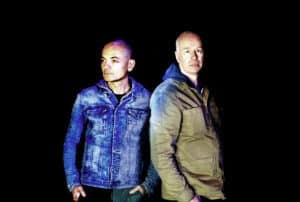
    Placing equal emphasis on music and visuals, French multimedia duo Gangpol & Mit create works that successfully combine the bizarre and strangely familiar. Their songs incorporate a wide variety of genres, from loungy soundtrack music to robotic bleeps and beats. At times, they really bounce around through different styles, but it never seems jarring or forced. Visually, Gangpol & Mit lean towards bright colors and highly geometric cartoon characters. Among other things, they have made animated videos and utilize projections and puppets for live performances.

    The latest Gangpol & Mit album, “The 1000 Softcore Tourist People Club,” came out earlier in the spring on Mike Patton’s Ipecac Recordings. The following is an email interview with member Sylvain Quément.

    Are you both involved equally with the music and visuals? If not, what is the collaborative process like in that respect?

    Roles are separate: Guillaume works exclusively on the visual side while I concentrate only on the music one. But we’re both equally in charge of the general artistic direction of what is created by Gangpol & Mit. Although I never make a picture and he never creates a sound, we constantly discuss a lot about the contents, meaning and processes, also give advice to each other, in order to tune music and visuals together.

    Are there specific ways that you feel visual side of things influences the music, and the music influences the visuals?

    Same processes and concepts run both the sonic and visual sides while we work: we capture, cut, paste, compose, mix … We use multi-layered systems, a few microsamples, structure or rhythm are important on both levels .. Therefore the link is strong and the influence high. It is specific in the way that the visual side – as well as lyrics – injects more meaning by breaking the music’s abstraction. Sound may influence the rhythm of a sequence, and has the power to magnify the emotional side. Whether we start from a few pictures, a storyboard, or a melody, we almost always start with a precise idea in mind: we’re gonna make a batucada played by a call-center team, a geometrical sexual tune, a ballad sang by a stock exchange tv speaker …

    When you perform live, are the video projections interactive? (perhaps live VJ’ing or synced up with the electronic musical instruments?)

    So far we used a very simple triggered live montage system.
    We don’t have a fascination for interactivity in itself, but like to focus on the content provided inside a simple technical setup: so far, one screen and short video sequence triggered live, with a few cardboard puppets shot by webcam too. But we’re currently working on our new live project for autumn: as we have a specific idea requiring multi-screen, we’ll have a whole new midi-triggered system and more interactions than the previous live set.

    What inspired you to do the “Cartoon Park” project aimed at children? Do you have any future plans for it?

    Since the beginning, we find a balance in having different projects playing for different kind of audiences.
    Carton Park followed our first experiences in playing for children, with the wish we had to work also with Mami Chan & Norman Bambi.
    First concert project was mainly intended to transmit to kids the idea that they can easily reappropriate entertainment through DIY tools instead of just watching it. Second project lead us to a more narrative and quiet show, based on the story of an amnesic girl on a deserted land having to fight bore and loneliness by various kind of activities: making music, making imaginary friends, making war …

    Could you describe the main instrumentation you use, both in the studio and on stage?
    Has it changed much throughout your career, and if so how do you think it has affected/influenced your music and/or creative process?

    We are mainly computer-based artists, injecting a countless amount of various small elements in it.
    We are always in search of a good balance, whether on studio or stage, between required control and entertainment for us and the audience, between personal vocabulary and the necessity to renew ourselves: cardboard puppets, electric kalimba and ukulele, vocoder harmonies … We have our trademark tools, but there’s definitely a challenge now in finding other ones and also surely going more acoustic in music despite all the technical lacks I may have.

    How did you get involved with Ipecac Recordings?

    One day we woke up with an email from Mike Patton in our mailbox.
    It looks like he heard about us thanks to a mutual friend based in Italy, Filippo, who runs a project named Okapi.
    I must admit this is a good way to wake up in the morning.

    There seems to be a spontaneous/improvisational feel to a lot of “The 1000 Softcore Tourist People Club.” Did you make conscious effort to capture spontaneity in the recording and try to avoid over producing/over sequencing?

    I’m highly happy if so, although it is probably still way too much over-sequenced.
    As a maniac and control-freak, I do lots of efforts trying to re-inject some feeling, spontaneity, warmth or body into the computer-based home studio process. Many of my headachy problems come from the fact that composition and producing times are not separate. This sometimes leads to lose the thread of a track, something I plan to avoid in the future by forbidding any arrangement, recording or mixing anything until composition in complete. So classic…

    With both the music and visuals, you bring together a lot of different ideas and influences. Are there any things that you feel have influenced you that perhaps don’t come through as immediately apparent/which people don’t normally pick up on?

    It is usually easy to track down influences when they are related to shapes and styles we combine and play with. But there are of course deeper ones, things we have nothing to do with in the field of shapes, but with whom I think we share a certain vision. I feel highly energised by a huge range of acts that are for me plain, complete, personal, achieved, in any style of music: for more detailed names, maybe check the indices we always spread through podcasts, blogging activities, events we sometimes organise.

    There does seem to be video game influence in your work, so I’m curious of your general thoughts regarding the way the look and sound of classic video games has made its way into other art forms?

    I must say I’m embarrassed because I don’t really see the video game influence in our work.
    To me, we do synth music that is not 8bit based, and geometrical shapes that are not really pixel related either.
    Of course I admit that we are highly digital, and follow computer composition principles inherited from something that has more to do with Tetris scores than with techno loops… But our influences come from synth-pop, exotica, early electronics pioneers, library moog records, and countless mondo hybrid music productions way more than from video game music.

    What is in the immediate future for you?

    Work in progress on that new show, with a countless amount of satellite projects.


  2. ohGr

    June 8, 2011 by admin

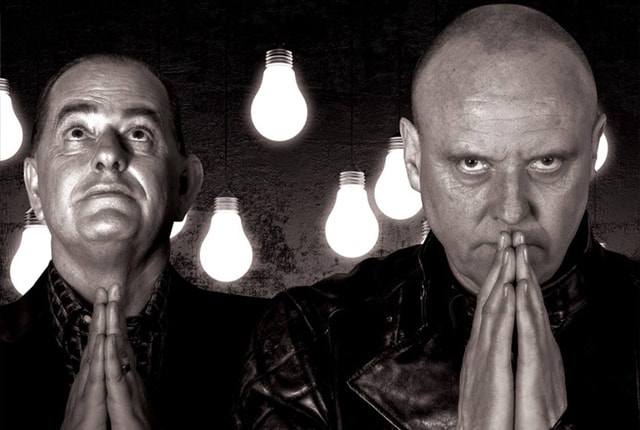
    The band ohGr dates back to the mid 90′s when Skinny Puppy disbanded and frontman Ogre began collaborating with Mark Walk (Ruby). The project was held back by record label legal problems, and the duo finally released a debut album, “Welt” in 2001 (Welt was actually the original name of the band). Since that time, Skinny Puppy has re-emerged, but the ohGr project has also continued. Their latest album, “unDeveloped,” came out last month and is in many ways a continuation of the 2008′s “Devils in my Details.” In a phone interview, Ogre discussed the release, as well as his recent foray into horror films. Be sure to also check out our 2008 interview with him.

    Creatively, how would you compare ‘unDeveloped’ with the last ohGr album?

    “Well ‘unDeveloped’ was kind of a continuation of what we started with ‘Devils in My Details”‘ in a sense that we’d stumbled upon something that was creatively satisfying and also took our listeners into more of an immersive journey and became more conceptual. “Devils” is kind of …. if the event I experienced was seen through a microscope, then in the case of “unDeveloped” it has been put under an electron microscope and further explored. I haven’t really let go of the themes that were running around in my head. In fact, they’ve just been exasperated or added to with events that have taken place since then. Lots of stuff to fuel that fire.

    “So ‘unDeveloped’ has become kind of a starting point in a way of circling back to a lot of our earlier work from the beginning of the 21st century up until now, bringing things full circle in a way, as well as keeping with that narrative that we started with “Devils in My Details.” We want to continue doing that more immersive exploration of the music and really create albums with conceptual ties between songs. It’s a really fulfilling thing to do for us, and on top of that for the listeners–taking them back to something that I enjoy, more of a concept album. It has that Eno sort of ethic in that you can play it in the background, or you can listen to it. But if you do choose to listen to it, there are a whole bunch of layers to the experience.”

    After finishing ‘Devils in My Details,’ had it always been obvious that you wanted to make the next release a continuation?

    “It was really to continue the process that we used in making ‘Devils in My Details’ and see where that goes. In today’s music market, there is a huge gap in how to deliver music to people and how to directly connect with your fan base. I was reading an article about some major thinkers in the music industry who got together, and basically threw it back on the artist. Saying that ‘the world is your oyster’ if you can market yourself and you can find a way to connect directly to your fan base. That has always been a tricky thing for me, because I always wanted to be a more mysterious character. I always enjoyed music that was less about the artist and more about the music and the art that went along with it. Hence my love for Factory Records and things like that.

    “So the idea of gravitating towards social media was very difficult for me until I found a way of playing around with characters. Because really, the internet is just a big characterization of a whole bunch of characters, whether people are trying to be real or not. The avatars become almost a caricature of what you really are. When I found that ‘in’ with it, to create characters, it became easier for me to do, and has become very very rewarding. We created a character called ‘Mr. Brownstone.’ Not ‘Brownstone’ in the Guns n Roses way of heroin, but more the idea of a brownstone being a place you live in, what you occupy. He’s ex-military intelligence gone rogue and is trying to inhabit certain celebrities’ lives in order to … well we don’t know why yet. So that was the story, and we were giving away these little puzzle boxes created by an artist that went along with each song. The puzzle boxes were out accordingly to puzzles that were given out by Brownstone. And these puzzles were things that would create a really obtuse viewpoint from all the fans, and the fans would create the fodder for the next puzzle in a lot of ways. It became an interesting way to engage with the fan base. That all came out of the development of ‘Devils in My Details.’ We’ve done so much background work with Brownstone and the website ‘Who Do I Have to Fuck’ [wdihtf.com], with Brownstone’s habitation, where he lives. We have a lot content we’ve developed.”

    Do you have a sense as to how this concept of characters will be utilized in a future live show?

    “It will be fun with the visual aspects, because obviously there will be more characters to play around with. And characters who actually have identities now, whereas in Skinny Puppy I tended to play a lot of different roles under the moniker of Ogre. It opens up a whole bunch of fun for me. In terms of how it will play out, we’ve developed a stage show that is more based around the fine art ‘white box,’ the idea of a gallery. It’s less about props on stage, as we’ve created a situation where everything is whited out on stage. We have every inch covered by projections, and the projections create the background and add to the story. We’re working to bring those into a more succinct fashion, to create backgrounds to the characters. I think that’s how things are going to move with the next tour.”

    Doing shows like this, is it a challenge conceptually to fit the older material in?

    “It really depends on the concept. I think that with Skinny Puppy, you can’t really go back to the songs that were done in the 80′s and try to reinvent the wheel. So you try to develop a show around it. For the last ohGr tour, we went out and basically did ‘The Devils in My Details’ in its entirety, which was a bit of a risk, and then at the end came back around to some of the older songs. It was very challenging for the audience, and I appreciate everyone who came out to those shows, because they hadn’t really heard the album. We toured about two weeks after it came out, so they were kind of in the dark about a lot of it but went along for the ride.

    “This tour is going to be a bit more about balancing out all of that, I think. We have four albums of material now, and all of the songs have an essence to them that fits into the paradigm I’ve created with the concept of Brownstone, this idea of too much information, this idea of disinformation, this idea of programming people, basically. These are things I am interested in right now. I read an interesting article about Google and facebook, how facebook delineates between what your choices are and makes those choices for you. This guy had friends from both the right and the left, and he noticed one day all of his red [right] friends disappeared [from his news feed]. It was based on an algorithm facebook has that makes choices for you based on your likes. Google does that too. What he’s talking about is the idea of info-bubbles, in a way. It starts to exclude certain information based on what your likes are, and that doesn’t make for a well-rounded person.

    “It’s something that interested me in terms of high-level information transfer. Because when we were in the 80′s doing Skinny Puppy, we thought that was the wave of the future, high-level information transfer. So we did all these cut-ups with videotape, as that’s all we had in the 80′s–very fast cuts to get a lot of information through. Now I’m seeing that I was wrong about that in a lot of ways, and there’s a detriment to that methodology in that you overload people and that in the end people just go to the most palatable, easy to digest answer. It might not be the truth, though. You can have something that eight billion people believe in, but if it’s wrong, it’s still false. I think that’s where we are heading, in a scary way.”

    You had Fangoria editor Chris Alexander write your press bio, and I see that you’ve been appearing at horror conventions. Do you see yourself crossing over more with horror audiences?

    “Chris is a fan, and we met back when I did ‘Repo! The Genetic Opera.’ He was a big fan of Skinny Puppy, and so he’s been very supportive. When I did the film, it kind of opened me up into that world. So I’ve done some conventions since then. And yeah, I think the horror audience is definitely something that has always been there for us, but hasn’t been a focus. So I think with the roles that I’ve had, and I have more coming up, it spills over. I see it at the conventions, people who don’t really know ohGr or Skinny Puppy but who know ‘Repo!’ And then they discover the music . There’s definitely a crossover, and it’s a good thing for me. It’s a fun time for me, in the sense of being able to cross over to a different genre of expression and take myself out of music sometimes. With music you have all the control, but all of the worry, so it’s good to sometimes go on a film set and be serving the production. You have so much responsibility with your own character, but you don’t have all the flotsam and jetsam that goes with it. Both experiences are really great, and both bring their fan bases for sure.”

    Do you have more film work coming up?

    “I do. There is a movie called “The Theatre Bizarre ” based on Grand Guignol, which is a period of French theater, I believe, in the 1800′s. It was basically plays loosely about plot and character, and more about gore effects. It became a sensation at the time; how much can you take, where will it go? Much like Italian horror cinema went in the 80′s. This movie is six different shorts. One is directed by Richard Stanley who did “Hardware” in the 80′s. Tom Savini’s doing one. And then I’m doing what in the old “Tales from the Crypt” Cryptkeeper did, appearing in a wraparound that ties these separate stories together.”

    Do you have touring plans to support the new album?

    “We’re looking to tour in August, and it seems to be coming together. The really cool thing is that this album is really brewing right now, which is good. I’ve gotten word back from Metropolis that it’s their best reviewed album ever. Whether that’s bullshit or not [laughs] we’ll see. There’s an event that might happen in Los Angeles that could make Europe happen as well. I’m keeping my fingers crossed and am very positive, as the times right now are obviously difficult for touring, not just for a baby band like ohGr. It looks like the numbers are working out, though. It’s not going to be a grand slam money maker, but it’s going to let us get out and play the music, which is what I really want to do right now. If we can get out and tour without losing money, we’re going to do it for sure.”