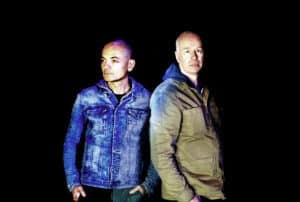
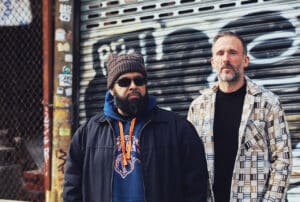
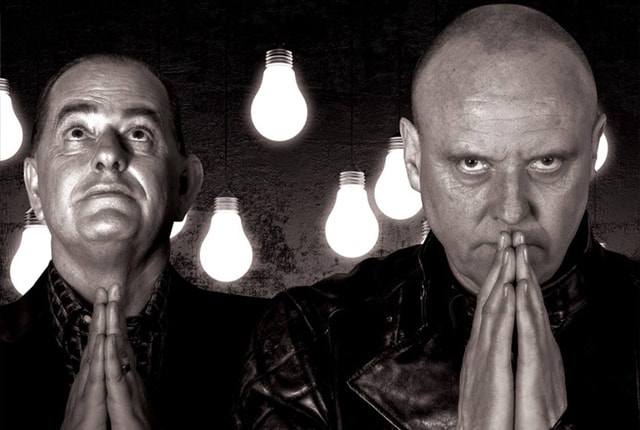
The full transcription of our recent interview with Ogre has now been posted. Check it out here!
-
Full interview with Ogre posted
November 30, 2008 by adminCategory: Music InterviewsComments Off
-
Ogre
November 7, 2008 by adminSkinny Puppy frontman Ogre is back with “DEVILS IN MY DETAILS,” his third release with ohGr. In the following phone interview, he discusses the evolution of ohGr, how tit differers from Skinny Puppy, his appearance in the film musical “Repo! The Genetic Opera,” and more.
How does the working relationship with Mark Walk in ohGr compare to that of Skinny Puppy?
Ogre: It’s a little different in the sense that cEvin and I always worked together, but separately, in a lot of ways. On the last few albums, we’ve bridged that gap a little bit. But it seems like for the most part within Skinny Puppy there is a coalescing that goes on when there are sort of separate inputs, and we both respect each other’s work in that way. After a 25 year relationship, I think we’ve found a way of writing that works within the context of Skinny Puppy. That is more of writing music, in a sense, by committee. In a weird way, I’ve always worked with people and I NEED to work with people. It’s my process. And Mark is someone who I met when we were recording ‘The Process’ back in Malibu in ’96 – that Rick Rubin record. We just became friends more than anything. I think for me, some of the greatest voyages you take are with someone who understands you and is empathic. I guess I gravitate towards people like that. Not because I’m special, but because it’s what I need. He’s someone who can read and pull things out of me that otherwise wouldn’t be accessible. So within a creative world, having that balance is kind of what has gotten Mark and I to the point where we’ve created this record.
Has the return of Skinny Puppy had any effect on your work as ohGr? Has having that creative outlet back changed your approach to ohGr at all?
Ogre: They are like 2 utterly different projects. The writing styles, for sure. It’s like an alchemic equation in a lot of ways when you put people together to make music. Especially when you get further along in your life and you become a lot more cohesive in working, there aren’t as many emotional spikes. But there are still differences in working with people. For me, especially, Skinny Puppy started off as something that was very internalized, and became externalized. And ohGr was always this fantasy project that has veered a bit more into real life. I’m kind of deconstructing ohGr in a lot of ways in my own life, in my own head. I always had a bit of a disconnect with my idea of being perceived as something. For example, people from the military coming to see shows where I’m doing a theatrical bit on vivisection and coming up to me afterwards saying ‘Oh, it was great how you ripped that fucking dog apart!’ I’ve toured with a lot of people, like Ministry, and have seen a lot of things over the past 25 years as far as how rock and rock performers interact with their audience on all levels. And I’ve always been a bit twisted up in my perception over reality in a lot of ways. The way I’m perceived over reality, and my projection back is equally as confusing at times. And I think the ohGr project for me is at last a way of unmasking and showing a different layer. In a lot of ways, things that people saw as scary in Skinny Puppy were really just a projection of things that scared them, or me.
Could you explain a bit about what happened with the original incarnation of the project, WELT?
Ogre: Well my life has been full of … I wish I could say I was an amazing businessman, or even at times a functional and deliberate artist. But my life has been paved with a lot of pitfalls, and ohGr came out of the time when we were finishing ‘The Process.’ We’d made the jump to a major label, and made lot of mistakes. It goes back to being young and having management take control of a huge amount of money. All of that bullshit. That ended with me leaving the band. We all got put in a house [for the recording] – it would have made great reality TV! It ended up with Dwayne’s eventual decline and his overdose. I’d left the band and started working on a record for Rick Ruben – contractually, it was a ‘leading member’ clause. They had first right of refusal, and the record ended up being stuck in a drawer. They kept me on the label for about 3 years, and wouldn’t let me do anything with the record. I went through a serious depression, and it wasn’t until about 2000 that I pulled myself up by the bootstraps and went to see what was going on. I found out that all that time, I could have just walked away from it because no one was going to do anything. I guess I was just young and didn’t understand that no one was going to put the financial effort into stopping little ‘ole me from doing anything when it came down to it. I guess Glen Danzig walked away and got a new deal with Hollywood Records. We went back and actually re-recorded the first record, and then did the deal with Spitfire based on the 2 albums. They came with a bit of baggage. We were pursuing this more fantasy aspect as a differentiation from Skinny Puppy, which was more into audio construct / audio sculpture and creating environments as opposed to writing songs. That was the impetus – to get into more of a songwriting mode. We worked in more of a melodic realm, focusing more on the vocal than we do with Skinny Puppy, which is more about huge audio segments with vocals over top.
How did the re-recording of that album compare to the original version?
Ogre: Well, with the original recording we were using a lot of old modular synths. We went and played in the studio for almost a month, with a lot of found instruments and we went to thrift stores. At the time, there wasn’t a big surge on the analog stuff and we bought a lot of old analog keyboards. We played around with using that in Pro-tools with the idea of diminishing the latency that was inherent in the old 80′s analog music. We wanted to bring that sound back, but using editing in Pro-tools to make it snappier sounding. That was kind of the vibe we were on back then.
Many bands have come along using a similar vocal style and effects as you. How do you feel about that?
Ogre: Well I was influenced by people like Stephen Mallinder from Cabaret Voltaire and Ian from Portion Control. Anyone who can listen to Portion Control will hear a huge influence on me. There were voices like that going on before. I don’t know where the differentiation is between what I was doing per se. It could be more so the effects put on the voice, which at time guide the song. I think the only thing that makes me smile is that if I can do it and can emote, then anyone has a chance. And you don’t need to be a vocal acrobat to get an emotion across. It’s cool that people are emulating it. It’s more of an instrument than it is actually a voice per se. I have to say that I think my voice has certain characteristics and tonal things, which again are almost atonal [laughs], which work within the context of the music that maybe people can’t duplicate.
How did you get involved with “REPO! The Genetic Opera?”
Ogre: I came back from the last Skinny Puppy tour and met my friend Joe Bishara, who was working as one of the producers on the project. He’d asked me what I wanted to do. One of my childhood fantasies was to be like Lon Chaney Sr., wear a lot of makeup, and be that kind of character actor. So it’s a first step to something like that. When I told Joe that, he said ‘Oh, we’re working on this film right now and there’s this one character that hasn’t been cast.’ It was Pavi, the face stealing serial killer rapist. And I said ‘Awesome. And it’s a musical? Even better!” It was a bit of a boot camp for me, in the sense of being on set and learning the etiquette and that whole realm of working, and the terminology. It was a great experience for that, because I didn’t have to worry about actually delivering lines per se within the context of blocking shots, because we’d recorded all the music a month beforehand. So it was a great experience, I had a gas. I was like a kid in a candy store.
Were you aware of who else would be in the film?
Ogre: I didn’t. In my audition, I had to do a monologue, and I came up with a character analysis. I had heard that Paris Hilton was doing an audition, but I wasn’t sure when or if she even was. It was just a rumor. So I was called in late one night. I think I was the last of two or three people to come in. I was sitting there, and I’d worked out this bit where I’d say to the director ‘Eh, do you want to see who fucking Pavi is? I’ll show you fucking Pavi.’ I had this mirror, since Pavi has a mirror. He’s very vain and narcissistic. I cut out a picture of Paris’ face and I put it in the mirror. That was my schtick. I was going to turn the mirror around to everyone and show them who Pavi was and who he wanted to be. So I was sitting outside practicing my lines and nervously waiting. I heard all this commotion. There were two sets of doors before it went outside, and I was in a hallway between these two sets of doors. One set opened and out comes this person, and I had the mirror next to me, and it was Paris. She went out the main door and there were all these camera flashes going off. I was just like, this is so fucking surreal. So I was like, do I do this thing or not? Do I do this bit? And I ended up doing it, and I think it’s what got me the part. I got to meet Bill Moseley, who actually did a bit on this record. He did a lot of the spoken word dialog and did this amazing one pass thing that we cut up into short segments. He did three or four poems in one pass, there were no additional takes. It was amazing. And then course Paul Sorvino, and Alexa Vega. Anthony Head from Buffy… it was a really cool cast. And the coolest part about the movie, bad or good … I’ve seen a cut and I like it, but I could be biased … but I think the coolest part of it is that it wasn’t really co-opted by a big movie company. It’s being done by the people who were actually involved with the street version of it, when they were doing 10 minutes shows in clubs and stuff like that. So it was kind of a cool family.
Would you like to do more work like this in the future?
Ogre:Yeah, for me what is really fun is going under intense prosthetics. Skinny Puppy has always been about mask work. It just opens me up in so many ways. I’m kind of an extroverted introvert, and that is the trigger that opens the door. If I could do more stuff like that … I can’t tell you how much fun it is. It’s a bit tough in the sense that your hours are longer, but I love to do stuff under make-up.
Have you ever considered doing a Skinny Puppy musical?
Ogre:There have been ideas. cEvin has had dreams, he’s told me, when he was younger, of some show on stage where there is this three-dimensional floating dragon. He’s had that kind of surround sound outlook of the future. And I’ve had ideas of taking something and doing more of a show. I was a magician when I was a kid, and I like the idea of the Chaos Magicians. Something in that realm might be interesting with scripted dialog. We’ll see. We have to start thinking about things like that now.
Was the use of spoken word recording specifically for the album meant to be a variation of how Skinny Puppy would use samples from films and other sources?
Ogre: It was. When it came to pass, we thought that it would be amazing if it worked out. There’s always that serendipity, the risk that it might not work in the context of the music . I was up in Toronto working with Bill. We’d hung out a little bit and become friends. He would read my his poetry. He wrote something each day, it was one of his many exercises. And some of it was just amazing. He wrote this one for myself and my new girlfriend. I asked him if he wanted to do it [work on the album], and he said ‘yeah.’ So right at the last minute, he came in just kind of spilled some things out and again it was just that kind of moment where it just all melded together. In retrospect, I think that it’s absolutely perfect how it turned out. The spoken word is something that definitely gave the album a few layers of icing on top. I’d love to work with Bill again … you talked earlier about expanding our show, and we’ve definitely had some conversations about things like that.
What did you chose to go under the name ohGr for this project?
Ah. It’s 2 syllables and again it’s an abstraction. The idea of apathy and anger, the long ‘oh’ and then ‘gr.’ That’s really all it was, an idea in my own mind of splitting apathy and anger.
What can we expect from the upcoming ohGr tour?
Ogre: We’re doing something that’s a little different, in the sense that Bill Morrison, who’s played with Skinny Puppy, he’s done a lot of video work – he did the “Too Dark Park” backing tapes, he did the “Last Rights” backing tapes, did “Killing Game,” did both of the Ohgr videos. He’s been a friend of mine forever. He’s a filmmaker, along with … he’s a renaissance person, but as a film maker he’s been working on all of these projects like a documentary on The Process Church of the Final Judgment and he’s been on a television series as well – an extreme cooking show! It’s a great show, too, the guy goes and does like the Guinness diet for a week, goes to Arizona and fries eggs out in the sun, that kind of thing. Anyway, he’s working on a project called The America Memory project 8gc (americanmemory.net) with Justin Bennett, who is our drummer. He’s gone to the Library of Congress and taken things like the Lakota Sioux ghost dance, and the uprising that was squashed; it was basically a dance they were doing when their lands were once again subdivided to bring in homesteads. They would start joining in huge groups and doing the dance called the ghost dance. It scared the authorities and the military so much that it was the thing that caused the Wounded Knee massacre and the genocide of the Lakota Sioux. So he’s gone in, and he’s amazing with compositing and editing, graphic editing and special effects editing. He’s done this 3 dimensional looking show that is interactive, and so that show is going to lead into our show. It’s very intensely visual. I’m really excited about seeing it, actually.
Category: Feature Interviews, Homepage FeaturedTags: aggressive, industrial, Skinny Puppy | Comments Off
-
Terrance Zdunich of Repo! The Genetic Opera
by adminAfter being pushed back from an April release, the highly anticipated movie musical “Repo! The Genetic Opera” will finally be unleashed on November 7, 2008. Based on a stage musical, the sci-fi/horror tale of a future where organs are harvested for profit has one of the most eclectic casts ever assembled. Who would ever have thought that Nivek Ogre (Skinny Puppy) would appear in a musical with Sarah Brightman (star of several Andrew Lloyd Webber musicals) AND Paris Hilton? In an email interview, co-creator/ co-writer / cast member Terrance Zdunich tolds us a bit about “Repo! The Genetic Opera” and its transition from stage to screen.
CAN YOU ELABORATE A BIT ABOUT THE EARLY HISTORY OF “REPO! THE GENETIC OPERA”?
Repo! is a project that’s been in the works for almost 10 years now. It started in 1999 when Darren Smith, Repo’s co-writer, and I began performing as a duo called “The Gallery”. We would write and play what we called 10-minute operas – short stories put to music – at rock clubs and coffee shops throughout L.A. As “The Gallery”, Darren was a sort of 1-man-band, playing all of the music, and I was a 1-man-theatre troupe, acting out all of the parts. One of our 10-minute operas, “The Necromerchant’s Debt” – the story of a futuristic grave-robber – is the tale that evolved into “Repo! The Genetic Opera”.
In 2001 Darren Smith and I assembled a small group of actors and musicians, and began performing Repo as 45-minute sets at clubs. During this time we work-shopped the music and story, keeping what worked and cutting what didn’t. In 2002 we felt that we were ready to rent a theatre and debut Repo as a full-length play. This was at Hollywood’s John Raitt Theatre. Following this run, we went back to the drawing board again, and then mounted a second version of Repo’s stage play in 2004 at W. Hollywood’s SplitID Theatre. This attracted the attention of an off-Broadway theatre company, Wings Theatre, which staged Repo in NY during the summer of 2005. It’s been a crazy journey, this Repo project.
AT WHAT POINT DID YOU FIRST CONSIDER A FILM VERSION? OR DID YOU HAVE IT IN MIND ALL ALONG?
Darren Smith and I always envisioned a world for Repo that was bigger than what could be done on stage, especially considering the limited funds that we had to produce all of Repo’s stage plays. As such, Repo’s libretto always read sort of like a screenplay. I mean, how are you gonna pull of a character with digital corneas that projects memories in a black box theatre? Plus, throughout Repo’s development I think that both Darren Smith and I were more influenced by film than theatre. In fact, we had “shopped” Repo as a movie to various industry people over the years. We’d always find it to be a tremendously difficult sell, mainly because Repo is really something that you need to see and hear to totally grasp. Imagine that you were asked to judge a song that you had never heard based only the lyrics. This is sort of what Repo was up against. In 2006, we had the opportunity to film a 10-minute short film of Repo, directed by Darren Lynn Bousman, which is ultimately what convinced the studio to make Repo The Movie.
WHAT ARE THE REASONS FOR THE DELAY IN THE FILM GETTING RELEASED? WHAT FACTORS MIGHT BE SPECIFIC TO A PROJECT LIKE “REPO! THE GENETIC OPERA”, AND HOW MIGHT IT REFLECT THE GENERAL STATE OF TODAY’S FILM INDUSTRY?
First, I want to clear up something: if you look online, it will say that Repo had 3 projected release dates: April, August, and November of ’08, with November 7th being our ACTUAL release date. While it is true that we originally intended to release the film in April, the August release date was the fabrication of someone on the Internet. It was picked up by everyone else and assumed to be true. But yes, our original plan for a release in April was pushed until November. This was due to a number of reasons – the main one being that the film took longer to complete than expected. I think that when Lionsgate set that original April release date, they were assuming that Repo’s post could be handled in the same way as the saw films, which they also distribute – i.e. they thought that Repo could be pumped out and ready to go within the year. They didn’t realize – none of us did, really – just how much work would be needed in the editing process of a movie opera, like Repo, where every bit of dialogue is sung. For example, if, in the editing process of a normal film (normal meaning, not Repo!), you decided you wanted to cut a few lines of dialogue, you could do so fairly easily. In a movie that’s all singing, if you cut a line of dialogue it may effect an entire musical stanza. Often times a change made in Repo’s editing bay would require a substantial musical rewrite, which of course is time-consuming – more time consuming than anyone was really prepared for. Also, Repo has quite a few more visual effects than the Saw films, which added time to our post-production schedule.
WHAT ARE THE MAJOR WAYS “REPO! THE GENETIC OPERA” HAS EVOLVED FROM THE STAGE VERSION TO WHAT WE SEE IN THE MOVIE?
To me, one of the main differences in the way a narrative is driven in a stage play vs. a film is that on stage you typically TELL everything, whereas on film you SHOW everything. As such, some of the songs that were the biggest hits on stage, the real showstoppers, were either cut or trimmed-down for the film. The idea of stopping-the-show in a film doesn’t really work. But on stage, you expect a big aria to end in several moments of applause before going back into the story. In adapting the libretto into a stage play, it was hard because some of our favorite Repo songs were trimmed to the point where they don’t necessary function as songs anymore, but more as brief narratives that forward the action or the story. Even though it was a difficult process, the film works better with these cuts made…much better. We were very committed to the idea of making this a movie experience, not just a recreation of the Repo stage play.

WERE THERE ANY MAJOR CHANGES MADE BASED ON FEEDBACK AT EARLY TEST SCREENINGS?
There were a few changes made following Repo’s early test screening, but most of the changes were problems with the movie that we were already aware of. We just hadn’t gotten to them yet (the test-screening was done way too early in my opinion, and featured a clearly unfinished print of the film.). That said, while I think there is value in listening to the opinion of your audience – Darren Smith and I always polled audiences from Repo’s staged performances – I think that a test screening, particularly for a movie like Repo, is a bad idea. I say this because Repo was never a concept geared toward the mainstream. It’s a goth rock opera for christ’s sake! So looking to a mainstream audience to direct what sort of changes needed to be made was a big mistake. For example, one of the biggest scenes/songs in the movie – and one of the faves amongst actual fans of Repo – is the scene “17″, a moment in the story where Shilo, Repo’s 17-year-old protagonist, rebels against her over-protective father, Nathan. This scene scored poorly with the test audience. Had we listened to that audience, we would have cut the scene from the film. We didn’t listen however, and I think we made the right choice because I don’t think that most of the audience in attendance at that recruited screening were Repo fans, nor will they ever be fans of Repo, no matter how many changes we made. It’s the classic example of trying to please everyone, and in the process, pleasing nobody. If Darren Smith and I set out to do something middle-of-the-road, I don’t think we would have come up with the concept of Repo, let alone stuck with it for almost a decade.
HOW CLOSELY DO YOU FOLLOW INTERNET DISCUSSIONS ABOUT THE MOVIE? WHAT ARE YOU GENERAL THOUGHTS ON IT? DO YOU FIND PEOPLE TO BE MORE/LESS CRITICAL THAN THEY ARE WHEN YOU ENCOUNTER THEM IN PERSON, ETC?
Well, the safety of that pulpit of anonymity that we call the internet always makes people bolder than they are in person. To me, performing a 10-minute opera about a grave-robber in a half-full, hippy-dippy coffee shop, screaming “GRAAAAAAAAAAVES” at the top of your lungs, takes a lot more courage than going onto a blog under a pseudonym and posting about how much you hate Paris Hilton, for example. That said, I do follow a lot of the internet buzz surrounding Repo, and I think that it’s great, both the positive and the negative. Over the last few months, I’ve been able to correspond with hundreds of fans who seek me out on myspace, or on Repo’s message boards: http://www.Repo-Opera.com. It’s really great to interact with these people, and see how this thing that I helped to create has inspired tons of absolute strangers to write me, to post their thoughts on the film, to make Repo-inspired art. I love it. I especially love that we’ve created something that just isn’t for everybody. I suppose that you could say that about anything, but Repo really is it’s own beast, and as such, I think it forces you, the audience, to take a side about the material. I think that most good art does this. And so far, we’ve received a lot of critical praise for our efforts, which is really great. We’ve also had the movie screened at a couple of festivals, and people have even showed up dressed as Repo characters.
CAN YOU EXPLAIN A BIT ABOUT HOW THE MOVIE CASTING CAME TOGETHER? WERE THERE PARTICULAR PERFORMERS WHO YOU KNEW YOU WANTED FROM THE START? ANY WHO YOU’D NEVER IMAGINED IN THE ROLES? HOW MUCH OF A ROLE DID MARKETING OF THE FILM HAVE IN CASTING (GETTING NAMES RECOGNIZABLE TO VARIOUS TARGET AUDIENCES)?
Unlike most Hollywood films, ALL of our lead cast had to come in and audition with a Repo song. In a movie like Repo, where everything is sung – and sung in a rather specific style – we needed to hear that the actors could “sell” an entire performance based on their singing ability. Even if we knew somebody was a great actor, for example, we still needed him or her to come in for a singing audition. As the creator, it was great to hear some really “big” actors singing my music, especially since almost everybody treated the material with reverence. It was also great that we pretty much ended up with the cast that we set out to get. Before Repo’s casting process began, the two Darrens and I created our “Repo dream cast” list, which included our top 5 choices for each of the main roles. Out of the 8 principal parts cast, 6 were names that were on our original dream list. And even the 2 that weren’t ended up being better choices than what we originally imagined. Ogre from Skinny Puppy, for example, who plays Pavi in Repo, wasn’t on our initial list, but only because we were being too myopic in our thinking: the original Pavi list was all actors, and didn’t include any singers. When Ogre’s name was brought up as a potential musician for the soundtrack, a bell went off in my head, and I thought, “holy shit, Ogre should be Pavi!”
HAVING MANY RECOGNIZABLE NAMES IN THE CAST, ARE YOU CONCERNED AT ALL THAT IT MIGHT LEAD TO PEOPLE HAVING PRE-CONCEIVED NOTIONS COMING INTO THE FILM, PERHAPS MAKING THEM MORE CRITICAL? FOR EXAMPLE, THERE MIGHT BE SKINNY PUPPY FANS WHO HAVE LONG THOUGHT THAT OGRE SHOULD BE IN A MUSICAL, SARAH BRIGHTMAN FANS EXPECTING SOMETHING A BIT MORE TRADITIONAL, ETC.
Unfortunately, I think that this is something that you really can’t avoid. That said, Repo presents all of these personalities in a way that hasn’t been seen yet. Not only because everyone is singing, but because each of the characters is physically transformed to fit into this bizarre world of Repo. For example, everyone loves to hate Paris Hilton, and when we released our first clip from the film, we got all these internet responses about how the clip looked great, but that we must have chosen to not feature Paris because obviously she must have sucked. It was fun to then point out to all of these people that actually Paris was in the clip, and was featured rather prominently, but they just didn’t recognize her. A bunch of back peddling followed, and then the conversation shifted to comments like, “oh, well, Paris is still the worst thing in the clip”. The reality is that the response from the handful of people who have actually seen the finished film – both those who responded positively and negatively – all of their comments seem to center on the bizarre world of Repo, and never seem to linger on the cast’s non-Repo personalities.
I THINK THERE’S AN INEVITABLE ‘ROCKY HORROR’ COMPARISON, ESPECIALLY AMONG MAINSTREAM MOVIE AUDIENCES, SIMPLY BECAUSE THERE ARE NOT MANY HORROR MOVIE MUSICALS OUT THERE. HOW DO YOU FEEL ABOUT THIS?
I love Rocky Horror, so I don’t mind the comparison. In fact, if the only relevant reference point for Repo is a legendary film experience that happened only once, and happened over 3 decades ago, then I think we achieved what we set out to do with Repo: something groundbreaking. That said, I think that there are some major differences between our two films: 1) Rocky Horror is a musical. Repo is an opera – i.e. Repo is singing from beginning to end, with no spoken dialogue; 2.) Rocky Horror is a film that completely lives by its camp value and never takes itself too serious. Repo, while it certainly has its share of over-the-top elements, is a real, human, coming-of-age story; and; 3.) Rocky Horror’s roots seem to be driven by the sexual revolution of the ’60′s and ’70′s. Repo, on the other hand, is inspired by the older, more universal themes that you would find in classic operatic tales. All that said, I think there will be some major overlapping between the Rocky Horror audience and the Repo audience, which I think is fantastic. I think that both films appeal to my kind of people: the freaks, geeks, and misfits of society.
ARE THERE ANY PLANS FOR FURTHER STAGE VERSIONS OF “REPO! THE GENETIC OPERA”?
I would love to see Repo brought to the stage again, but I think that this will all depend on how the movie performs. If we can achieve Rocky Horror status, then I imagine that Repo will be produced, and reproduced, and reproduced again. I’ve already received multiple requests by theatre companies throughout the world inquiring about Repo’s stage rights. Either-way, I suspect that there will be official, and unofficial, Repo stage shows for years to come. I look forward to the possibility of sneaking into a rogue Repo performance, incognito, and watching other people do their own interpretations of the world of Repo, and of my alter-ego, GraveRobber. Honestly, nothing could be more flattering.
DOES THE DVD VERSION HAVE ANY SPECIAL CONTENT THAT YOU’D LIKE TO POINT OUT?
I honestly don’t know what will be included on the DVD. I turned over some 2002 footage of Repo being performed at a club in Hollywood to Lionsgate, so it stands to reason that some of this will make it onto the Repo DVD. Also, there was about 40-minutes of filmed footage that was cut from the theatrical print of Repo. I hope to see some of this on the DVD as well.
Category: Feature InterviewsTags: film, horror | Comments Off
-
Meat Beat Manifesto
by adminBy continually pushing the creative limits of sampling technology, Meat Beat Manifesto have managed to remain just as innovative as they were when they unleashed “Storm The Studio” back in 1988. Elements of such styles as dub, hip hop, industrial and jazz have been heard in Meat Beat Manifesto’s music throughout the years, but their sound has never been derivative of any particular style. Rather, founder Jack Dangers and whomever he is collaborating with at a particular time use electronic music technology to get around any type of musical boundaries that a more traditional band may encounter. Meat Beat Manifesto are back with a new CD, “Autoimmune,” and are hitting the road with a truly multimedia live. In the following phone interview, Jack talks about the beginnings of the band, video sampling technology, and more.
I read that XTC played a part in your getting into music. Could you elaborate on that?
Oh yes, for sure. If it wasn’t for me getting a little intern job at the only recording studio in Swindon in 1981, I wouldn’t be doing what I’m doing now. I actually got to see them rehearse for “English Settlement.” They never actually did that tour, because it was when Andy Partridge had a nervous breakdown. So I actually got to see that tour … I was the only one watching it! [laughs] It was in this rehearsal space, with me sitting on all these flight cases wondering why they’re not telling me to get out of the room. So yeah, that changed my life. It got me thinking, ‘well, I want to do something like this.’
When you first started, did you have any expectations as to what you thought it would be like being a musician? How might have things turned out differently than you expected?
I’ve always worked with independent labels, and if I’d signed with a major that might have altered some things. Just because of the people I know, bands that have experienced that. XTC being one of them. I think you’ve got more freedom being on a smaller label. The bigger the label, the more money you’re getting and the more you’re going to have to do what they want. With the exception of rare occasions.
That was the route I took. Who knows where it could have gone. I was always satisfied. If I can inspire people to make music, that is my achievement. I’ve always thought there was something different about what I am doing. Having that in the back of my mind is what keeps me going. I try to make things sound different from other people, even if I am using certain things from whatever this week’s moniker is for electronic music. I’ve been using elements of dub in everything I’ve ever done. Jazz as well.
Wasn’t the new album, ‘Autoimmune,’ meant to be a double disc?
Yeah, a year ago it looked like it would be a double cd. I had like 30 tracks, but just wanted to shave off some of them and go for quality rather than quantity. Which I didn’t on ‘Subliminal Sandwich’ – that was quantity! [laughs] So I narrowed it down to one disc of, to me, the most immediate tracks.
Will the other songs be coming out at some point?
Oh yeah, there are a couple of tracks with vocals that I did all the way through. They’ll be coming out. Probably via some digital source, as it seems to be the easiest way to do it these days. There are some tracks that will be appearing on compilations as exclusives, and things like that. Eventually, I think they will all come out, and we’re doing some of them live, too.
What was it like revisiting early material for the “Archive Things/Purged” release?
It’s a cathartic thing. I was always happier with the demo versions that I did on a Portastudio than the first 2 twelve inches which we put out. And so was the guy who used to run Sweatbox Records [Rob Deacon], who died last summer in a horrific accident in the English Channel. He always thought that the Portastudio versions have more bite. So it was partly on his insistences that people hear what the original demos sounded like. That was the main reason. I still think that it sounds better. ‘I Got The Fear,’ that was the first 12 inch. It was like I had all the freedom and all the time in the world doing these tracks, and then you get put into a studio which you don’t feel comfortable in, and you don’t know your way around. Things can just change.
How progression of technology over the years affected the way you work?
Technology has changed so much. It’s definitively made it easier. What we’re doing live could never have been done 10 years ago. We use like 5 different programs to get to the point where we can play back the visual samples live. We’re still waiting for that Roland box that will be able to do it all in one easy go. But it looks like that’s not coming out yet. The nearest thing is DVJ, but you’re sort of limited in what you can do. It’s sort of like a record, you can scratch it, and you can wind it backwards and forwards. But with our setup you’ve got more control. I’ve always said that technology dictates which way electronic music is going to go. It’s always about using the latest equipment.
If someone did come out with an all-in-one box, do you think you’d be satisfied? Or would you connect it up to other stuff to try to do things beyond what it is intended for?
Oh yeah, we’d have to get in there, rip its guts out, and make it do something nobody else is doing. Do you know Ariel Pink? If you ever heard any of his stuff, you cannot tell what year it is from because he does everything on cassette tape. It gives it a real edge. He’s a really good songwriter. You should check his stuff out.
You seem to have moved away from vocal-driven songs. Why?
Yeah, I don’t know. If you listen to ‘Storm The Studio’ there’s vocals for all of the songs, but there are 4 different versions of each and not so many vocals on the other versions. I use vocoders a lot, so I tend to do just as many vocals but they are effected. Live, I’ve still got three microphones on stage. I haven’t given it up completely. I don’t know. I was repeating myself a little bit, but some people like that. They like it if you go back to an older sound. There’s a track on the new record called ‘Solid Waste’ and that sort references an earlier sound. It was done for the Black Smoke Organization, this Greenpeace compilation album. That’s where that track came out of, and is why it’s got an environmental pitch to it.
What material can we expect to hear on the tour?
Well, we’re playing stuff from ‘Storm The Studio’ onwards. So it’s a bit of everything, not just from the new album. Lynn Farmer is coming out with us to play drums, as well as Mark Pistol and Ben Stokes. Ben and me will be mainly doing video samples, and I’m using the vocoder and doing vocals. It’s different than the last tour. A lot of the spoken word stuff from the earlier albums [is being represented visually]. I didn’t have a rich record collection or even many record shops to go to in Swindon, so a lot of the spoken word stuff I got from films and television. I kept all those VHS tapes and stuff, and was able to go back and find all these pieces of spoken word and attach the visuals to them. So you can see where it came from. There’s a lot of that going on live, and if you know the music you’ll think ‘oh, ok, that’s where that’s from!.’
Do the visuals have any influence on song selection? For example, are there tracks that you might not do because you don’t have accompanying videos?
Not so much. We use a problem called Live and you’re able to do pretty much anything. We’ve got it chained to trigger lights and stuff like that, and actually move robotic cameras. You can see that happening live. We’ve put 40 songs in there so we can be on stage for 3 hours if we wanted to. So it depends on what the mood is. Visually, I’ve got so many different samples that a lot of the time we are improvising. It changes from night to night, and there’s no real anchor. ‘Nuclear Bomb’ has got certain things that we’d have to use in certain places or else it’s just going to be a mess, but on the whole it’s definitely open to improvisation.
You mentioned possible digital distribution for tracks that didn’t make it onto ‘Autoimmune.’ What are your general thoughts on digital music distribution?
I got an email from someone in New Zealand who is not able to get the digital release because the territory is different. So it’s sort of going back to what record labels were like. I was signed to an independent in Belgium but they licensed to a major over here. It was actually Mute through Elektra. The whole structure of music has completely changed over the past 10 years, in how you buy it and listen to it. But I don’t even know anymore. It’s on iTunes, but you can’t get it in New Zealand? I didn’t know that until today.
I like the ease of being able to pull a track down which you haven’t heard in 30 years and buy it for $1. I’ve bought tons of stuff that way. I’ve never illegally downloaded anything in my life. I like to think I’m supporting musicians that way.
Category: Feature InterviewsComments Off
-
Laibach
by adminThe following is an email interview with Ivan Novak of Slovenian industrial / neo-classical band Laibach. It was conducted in September 2008, just prior to the band embarking on a short US tour. Laibach had most recently released “Volk,” an album of songs inspired by national and pan-national anthems.
What can we expect from the current tour? For long-time fans, how might it compare to your last visit to the US? And for people who have yet to see Laibach live – what can they expect from the experience?
Laibach: Great depression, economic implosion and subsequent recession, financial crash, bankruptcy of the entire U.S. economy, food stamps, catastrophic meltdown, the relentless drumbeat of pessimism,…nothing good. In fact – the less they expect – the more they will get.
In the “Divided States of America” documentary we see a long-time Laibach fan who has brought his 2 young daughters to your concert. What do you think of the fact that the age range of your fanbase is expanding, as your long-time fans are getting older and introducing their children to your music?
L: That proves that time after all is reversible.
What kind of impact has the growth of the internet had on Laibach? I assume that it’s expanded your fanbase and allowed existing fans to keep up with what you’re doing. But what about the fact that it allows people to more easily discuss the band and express their opinions about your work? Does this type of feedback have any influence on what you do?
L: With the internet all music acts fan base has expanded but in reality everybody’s audience was reduced, record sales went down rapidly and expression of opinions has mainly been limited to a vocabulary, commonly used by mentally incapacitated persons. There are very few feedbacks on the internet actually worth reading. The internet also was supposed to be the globalization tool but in fact it creates an even bigger cultural and economical provincialism and isolationism. Online communities are dangerously separating and dividing people on those who share common interests or goals but eliminating others who do not fit in the same social frame. Nevertheless the overflow of diverse networking sites successfully works mainly to turn users into profits.
What was the motivation for doing “Volk,” an album of songs inspired by national and pan-national anthems?
L: We were always fascinated with the idea of an anthem – the song entire nations identify with emotionally and sing from the heart. We were wondering why this is so and does that make an anthem actually a good pop song, and – vice versa – are pop songs also good anthems. We wanted to know what these anthems are really talking about and when we started to dig deeper, we came across very interesting results which are now recorded on the album. By definition an anthem is a composition to an English text. The term has evolved to mean a song of joy and celebration, usually acting as a symbol for a certain group of people. A national anthem is a generally patriotic musical composition that is evoking and eulogizing the history, traditions and struggles of its people, recognized either by a nation’s government as the official national song or by convention through use by the people. These are all basic characteristics of a good, standard pop song as well and this is what we do on Volk – showing analogy and dichotomy between the two.
The album credits cite Wikipedia as the source of the liner notes information about the anthems. Wikipedia has received some criticism because, being generated by the general public and giving them to power to make changes, at any given time a particular article might not be entirely accurate. Did Laibach research to confirm information, or was the potential for inaccuracies (due to the nature of Wikipedia) part of the point artistically?
L: It was a practical decision. We had no intention to do a scientific research although we have double checked most facts. But yes, we did use internet as a main source of inspiration. Ten or fifteen years ago we would have much bigger problems to gain all necessary information in creating such album.
You’ve done some very interesting rock cover songs over the years. What factors tend to make you want to create your own interpretation of an existing song?
L: We are searching for the hidden content in these songs, for their hidden reverse. We enjoy adopting, appropriating and recycling them – producing new “original” material with them, putting them into a new context which can draw entirely new meaning.
Are there any covers that were attempted, but did not work well enough within Laibach’s style/instrumentation?
L: Not that we recall.
Have you ever had any feedback from the original artists of songs you’ve covered?
L: As a matter of fact we had quite a lot. Paul McCartney was playing our Let It Be record before some of his shows, Mick Jagger was apparently most sympathetic to our 8 Sympathy For The Devil versions, Europe came collectively to our show in Stockholm to meet us, Opus were performing Laibach’s version of Life is Live in – what they thought was – a “laibachian” style on Austrian TV, and Freddy Mercury died soon after he heard our interpretation of One Vision.
Looking back, what do you think the pros and cons were of having emerged during the surge of “industrial music”?
We meet with people like William Burroughs, Timothy Leary, Joseph Beuys and Hermann Nietsch, we traveled through Eastern and Western Europe, East and West Berlin, SSSR and USA, we lived through communism and capitalism, and music/noise/sound was still making a lot of sense. The bad side about emerging during the surge of “industrial music” is the fact that we now still have to live with that.
Besides the current US tour, what is in the near future for Laibach?
We are doing some LAIBACHKUNSTDERFUGE shows (with electronic interpretation of Bach’s “The Art of Fugue”), also preparing a WAGNER suite (with an orchestra and diverse collaborators) for a December show in Ljubljana, we are starting to work on a new Laibach “pop” record, and slowly preparing a big LAIBACH KUNST exhibition in a Museum for Modern art in Lodz, Poland, to be opened next year in May.
Category: Feature InterviewsTags: classical, industrial | Comments Off
-
Juno Reactor
by admin“With this album, I just wanted it to be different, more like an iPod on shuffle,” says Juno Reactor’s Ben Watkins on why the recently released ‘Gods & Monsters’ is his most varied album to date. “The way people listen to music nowadays, and the way I listen to music, isn’t to sit down and listen to a whole album. I listen to a whole lot of stuff flung together. And I thought maybe that would be a good way to approach an album.”
Working with a wide variety of musical collaborators, Watkins has come up with a highly cinematic sounding collection that ranges from pounding dance tracks to jazzy down-tempo to the first Juno Reactor songs driven by his own lead vocals. In the following phone interview, Watkins discusses the making of “Gods & Monsters,” his approach to collaborations, why he chose to do his own vocals, and more.
What can we expect from the upcoming tour?
In Europe now, it’s the whole show. We’ve got a lighting crew now; I don’t know where we picked them up! [Laughs] In Japan, I met this guy named Yoshi who does these amazing visuals, pretty much like doing a VJ thing but it’s just really, really brilliant. A lot of VJ stuff I see looks like crap; they haven’t got much artistry to it. But this guy is just amazing. The music is cinematic anyway, and the way the visuals are working draws you much more into it. It’s almost like an installation at times.
So we’ve got the 4 South African percussionists, Greg from LA who is the kit drummer. Sugizo, who is this Japanese rock star guitarist. And then Taz [Alexander] singing and Ghetto Priest, who came out of Asian Dub Foundation. Sometimes Steve Stevens plays with us. So it’s quite a mad mix of people, really.
Do you have any specific ideas of how you’d like the live show to evolve in the future?
The thing that I’d love to do at the moment is to just tour throughout Europe the way that I want to, with this band. That is my dream, to be on a really solid tour where you’re not worried about how you’re going to pay for it. That would be great. To just get it out to the people who really want to see it. I think that what we’ve got now is so unusual, visually and in terms of the makeup of the band. Because it wasn’t really designed this way, it just happened. I think we’ve just found ourselves with something that is incredibly unique. You have to go back to bands like Parliament to really find something that is similar.
You’ve collaborated with quite a few people. How do these collaborations usually come about? Are they people you know, or seek out?
Usually, I just fall into them [the collaborations]. I think the only one who I’ve really hunted down was Yasmin Levy, who sings on the new album on a song called “Tanta Pena” I heard her on BBC Radio 3 here, on like a world music program. And I was just amazed, so I rang up the radio station and got in touch with her management and she came down to the studio.
Is it ever a challenge to integrate a particular collaborator’s skills and talents into what you’re doing with Juno Reactor?
It’s a challenge if they’re boring. [laughs] It’s a real challenge if what they play is a load of crap. It’s just exciting when you find someone like Mike Garson, Bowie’s piano guy from Aladdin Sane and stuff. It’s exciting when people have got their own personality and sound. It would be a problem if I had to keep it to a particular type of music, but I don’t feel like I have to.
Do you generally prepare in advance for a collaboration, in terms of perhaps creating the beginnings of a song that is tailored to the people you are working with?
Not really. Someone like Steve Stevens, with “Pistolero,” he came over to London for about 6 days and we spent the first days going ‘nah, nah, maybe too slow, too fast.’ And then I found a bassline that I thought we could really do a lot with. It was neither major nor minor. And then he started kicking out the beats. In that case it was very much a 50/50 type of collaboration. With Mabi, the bushman from South Africa, I took a load of his rhythms and just sampled them up at first to get a basic idea. Then I knew I had something that he could play over. So sometimes I do have to tailor it, and other times I don’t really.
Since you’re music combines so many different styles, do you strive to come up with a cohesive sound? Or do you just let the music naturally take it’s own course?
I’ve found this album to be the least cohesive of all. Because I think in the past it’s been easier to say something like ‘well this is a cross between a dance record and something you can play at home’ or ‘this is an out and out sort of banging album.’ With this album, I just wanted it to be different, more like an iPod on shuffle. The way people listen to music nowadays, and the way I listen to music, isn’t to sit down and listen to a whole album. I listen to a whole lot of stuff flung together. And I thought maybe that would be a good way to approach an album.
What made you decide to do two songs driven by your own vocals?
I think I just wanted to write more songs. For a long time I’ve been doing things where the tracks and the music do all of the speaking.
I don’t know why … I’m definitely not a poet, and I don’t sit around writing words all the time. But on this album, I just found myself writing loads of lyrics and sitting at the piano writing songs. And I thought maybe something was telling something me here. So it was natural to do it. I love working with Ghetto Priest. That writing partnership was really easy and relaxed and fun, and all the lyrics just came so easy. Before when I used to write songs, the lyrics were a nightmare. And I quite like the idea of the path of least resistance. I think that was it really, those songs just naturally came. The hardest part was finishing the songs and thinking ‘hmm, people are going to think I’m fucking blarney for putting these on!’ But some of it is really autobiographical, and I’d never written an autobiographical song before.
Did you put them at the end because they are different from the rest?
Well I had thought about it. I play around with a lot playlists all the time, and I found that’s where they sat best. They’re not trying to be hidden [laughs].
Do you have a particular approach the naming songs?
Well I always know what the track is about. For example, there was a track called ‘Jardin De Cecile’ that I wrote. That was about this French girl, about 18 years old, who got murdered on the motorway in England. And where they found the body, her father wrote on a tree ‘Jardin De Cecile.’ And I read that and thought …. I think it was because I had just had my own daughter as well … I was working on this track at the time and thought, ok, I’m going to re-arrange it and turn it into this sort of magical garden, the garden of the afterlife. I tend to have a film in my own head as to what a song is about. The hardest part is if you don’t have an idea of what a song’s about, then I can’t really be finished.
Are there any particular instruments or pieces of studio technology that you feel are key to Juno Reactor’s sound?
I’m a whore really, I use everything. Anything that is good I use.
Has the evolution of musical technology had an impact on your creative process?
I’m sure it has. I’m sure it makes me want to sit at the piano a lot more. Sometimes you get so bored sitting in front of the computer nudging little buttons and looking at the bloody screen that when you actually sit in front of an instrument it’s almost like you’ve reached nirvana. I think it’s really made me appreciate the sort of physicality of playing my guitar or the piano or drums. I love programming as well, don’t get me wrong. But I spend so much time doing it. And then you’ve got every bleep and blop that everyone else can make. You’ve really got to dig quite deep to find something unique. I think. It seems that every bleep and blop and compressed noise has been created now. Everything has been done, it’s been cooked and overcooked. For me, it’s down to the individual and the musician’s expression that then makes something hit a chord or a soul or connects people more. I mean I can make a really massive thumping demonic dance track that’s great for that night or whatever. But you want your tracks to live, and have their own soul. And that is down to the players.
Can you describe the recently released live DVD?
It was shot in Japan over one night. It was really the first time I’d taken the band [out of Europe] with it that big. We had Steve Stevens on guitar for the whole gig. Paul Jackson on bass. It was quite a magical night, because it could have gone really badly. But luckily the gods were with us and it all went really well.
Do you plan on touring America to support this album?
Well I’m hoping so. I’m hoping that we get the right agent who can put a tour together.
Will it need to be scaled back at all from what you’re doing in Europe?
I hope not. There are a number of places in America that really want us and think they’ve got the audience to be able to pay us for the full caboodle. I mean if we can do it in Europe, in places like Ukraine and Croatia and Bulgaria, surely we can do it in America. But maybe not? Maybe George Bush has taken America too far into the third world for you to come back [laughs].
Do you have any more film work planned?
I’ve got some coming up later in year.
Why do you use reactorleak.com for your official website, as opposed to junoreactor.com? Was junoreactor.com taken by someone else?
It was started off by a Juno Reactor enthusiast and he let me take if over. I just quite like it really. I’ve still got Junoreactor.com, but I quite like using reactorleak.
Category: Feature InterviewsComments Off