Chaos Cotrol Digizine

THE LATEST | ALL INTERVIEWS | NEWS BLOG | ABOUT CHAOS CONTROL | CONTACT

  1. The Cyber-Tec Project

    November 14, 1996 by admin

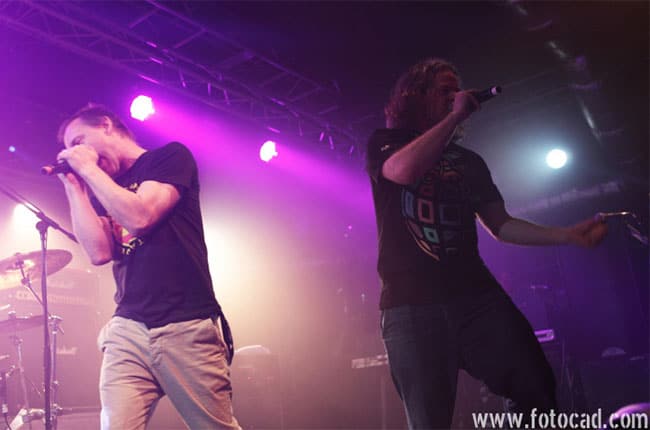
    The following is an interview with Jean-Luc De Meyer, vocalist for Front 242, The Cyber-Tec Project, and now, Cobalt 60. Originally, it was meant to be an in-person interview to have taken place before The Cyber-Tec Project’s New York show in February, 1996. Unfortunately, technical problems at sound check prevented Jean-Luc from doing the interview. So instead it interview had to be done by fax.

    How did you get involved with The Cyber-Tec Project?

    Jean-Luc: “I knew Paul Green, the manager of Cyber-Tec Records, since a long time. He sent me tapes with material of some of his artists. There was some cool stuff on there, and I proposed to sing on some songs. I had no other project at that time, and I knew it was going to be fun. And indeed it was.”

    Going into the project, did you have and specific ideas of how your wanted it to turn out?

    Jean-Luc: “I had no idea in mind before we started, I just liked the songs. In fact, I made it very clear since the beginning that I didn’t want to be involved in anything more than the writing and singing of the lyrics. And for the production of the EP, the remixers were given total freedom. There are the ones responsible for the sound.”

    Paul said you were having technical problems at the recent NYC show. Does that happen often with the electronic gear?


    Jean-Luc: “Well, we did have technical problems BEFORE the show that prevented us from doing a decent sound-check and didn’t help us making our performance easier, but that’s the way things happen during concerts. We never really had many breakdowns with 242, the last I remember happened during the Lollapalooza tour when a roadie threw a cable over the Macintosh computer running the basics of your live show. The cable hit the space key and caused the immediate stop of the song!”

    What’s the statues of Front 242?

    Jean-Luc: “242 is dormant. We all enjoy our separate projects. We’re still friends, we still talk. But we don’t feel the need to work together again right now. We might in the future. 242 was a dinosaur, we had/have our own studio and tons of equipment, constantly worked under pressure, while CTP works with little equipment in a totally relaxed way. In fact, CTP makes me rediscover the meaning of FUN.”

    When can we look forward to a new Cyber-Tec project release?

    Jean-Luc: “The LP is written. We only need to record it. It should be out on the end of the year.”

    You also sang on BiGod 20′s “The Bog.” How did that come about?

    Jean-Luc: “Just like with CTP. I heard a tape, liked the song, phoned, took a train, recorded it.”

    Are there any particular types of collaborations you’d like to do in the future?

    Jean-Luc: “I would like one day to sing with a female vocalist but at the moment I feel there are already too many people doing it.”

    Why doesn’t the current Cyber-Tec CD have a track listing?

    Jean-Luc: “I think the record company didn’t receive any, or forgot to print it! Here it is.”

    1. Let your body dis (Birmdingham 6 ‘Convulsive Dance Mix’)

    2. Human (original mix by Cyber-Tec & Tim Woodward)

    3. Cauterized (K-Nitrate ‘EBM mix’)

    4. Let your body die (original mix by Cyber-Tec & Tim Woodward)

    5. Radience (original mix by Cyber-Tec & Tim Woodward)

    6. Let your body die (Cubanate mix)

    7. Cauterized (original mix by Cyber-Tec & Tim Woodward)

    8. Human (Machine Manitou ‘Body-Tec mix’)

    9. Let your body die (Television Overdose ‘Overdosed mix’)

    10. Let your body die (K Nitrate ‘Body-Tec mix’)

    11. Human (Maff Evans ‘anar trance mix’)

    12. Let our body die (K-Nitrate ‘Allied forces mix’)

    Are you currently working on any other projects?

    Jean-Luc: “Yes, the first is what I consider as MY new band now, called COBALT 60. It’s a fast & melodic combination of techno rhythms and sampled guitar that I could define as a kind of techno-Ramones. The second is the next Birmingham 6 LP to be recorded in April 96 where I wrote the lyrics and will sing on several tracks.”


  2. Baby Fox

    November 7, 1996 by admin

    On “A Normal Family,” their debut CD, Britain’s Baby Fox take elements of dub music to a strange new level. Their songs are all catchy and well-crafted, but at the same time the group creates an off-beat, slightly eerie atmosphere.

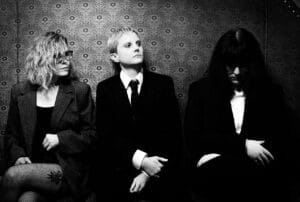
    Baby Fox is comprised of Christine Ann Leach, Alex Gray, and Dwight. Before becoming a band, the trio had been friends and worked together on their own club nights. Baby Fox, the band, was born when the three members met up in Thailand at Christmas time a few years ago.

    “It was just really a creative urge, we wanted to present something that I guess is what they call multimedia now,” says Alex on the club they ran beginning about five years ago. “But at the time we just wanted to somehow sort of forge Lee Perry, Jimi Hendirx, and kind of film loops and all that kind of thing at the same time.”

    The space the group used was the basement of a house, formerly part of a railway station, where Dwight was living. They weren’t themselves interested in the DJing side of the club, preferring instead to focus on filling the space with from loops and projections with sound systems came in to provide the dub music.

    “In fact, it was almost like we had the idea for this sort of movie making way of doing stuff, sort of creating these environments with music before we actually hit the music,” says Alex. “Although me and Christine, we had a lot of musical projects going on at the same time, this was a nice little diversion because we all got involved in something we hadn’t done before. It would be taking a soundclash and putting it into more of an art space environment.”

    Within the group, each member has somewhat of a defined role, but as Alex puts it, they’re “very much sort of stepping on each other’s toes.” Christine and Dwight both sing and write their lyrics, with Christine doing the lead vocals. Alex focuses on the sampling/sequencing/mixing.

    “Someone will hum a little melody that I’ll tranlate to a melodic line and develop,” explains Alex on how the trio works together. “Dwight is always kind of like fucking around with samples, looking through records and stuff. Quite often I’ll modify those. It’s really chuck it all in and see what happens, but we kind of know what each other’s likes are so there’s almost a kind of unspoken language. It’s quite exciting to see one of us get off on the idea of another. Somehow an alchemy kind of happens.”

    “Johnny Lipshake,” the first track on the album, is a good introduction to the unusual world of Baby Fox. The dreamy, minimal dub bass line is surrounded by subtle yet jarring samples – industrial noises, jazzy hits, even the line “Can You Dig It” from the film “The Warriors” (made famous by the PWEI song). The sweet vocals of Christine are a sharp contrast to the more dead-pan, slightly evil-sounding voice of Dwight.

    Baby Fox began as primarily a studio project, but they weren’t afraid to make the transition to live performance. It proved to be a difficult task, as the studio environment had a big impact on the way Baby Fox’s recorded music turned out.

    “It’s a diversion for us because, because there’s a vibe and an energy on the CD but it’s not a very live sounding project so it’s quite a big transition,” says Alex.

    While “A Normal Family” only contains a suggestion of guitar, the group is happy with live member Graham’s “atmospheric and dubby” playing of the instrument and may use more of it on the next album.

    Though just recently released in America, “A Normal Family” has been out in the UK since late July. Since finishing the album, Baby Fox have been busy putting together a live band and then touring. They don’t have any plans to for US shows yet, but hope to do so some in the spring.

    “There’s so much that was sampling, we could have just made sure we had all the samples and just kind of play those, but we wanted to take it one stage further,” explains Alex. “The problem at first was actually just getting the attitude across, I mean it’s a very kind of drifty, laid back sound on the album. It was quite difficult to adapt it to live, while still retaining the Baby Fox magic identity, which is something we’re not quite sure how to pin down. It’s sort of magic when it happens in the studio. There’s no kind of set way of doing it all. But I think we’re really well on our way now, we’ve done a lot of rehearsing and lot of checking out of ideas.”

    Alex feels that when getting into live playing, and the dynamics it introduces, it’s inevitable that music will get at least a bit more rock-oriented. He cites the minimal drum tracks on the album as something that can’t be reproduced live without reinterpretation. But Alex has no regrets about the way things were done in the studio.

    “I still like the idea of fucking with the sonics and not having real playing,” he says. “I like the idea of having maybe real sounds played by a non-player. Because I’m not a drummer, so the way that I kind of have drums programmed and arranged it’s a different perspective. I like it when someone has lots of ideas but not the orthodox means to actually do it so it comes out a little bit weird and different. It has an added sort of naivete to it.”

    In concert, Alex and Dwight play keyboards, and additional musicians playing live guitar and drums fill out the sound. According the Alex, the live sound engineer manipulates the music as if doing a remix.

    Because adapting the music for live performance has been a challenge, Baby Fox haven’t had a chance to fully utilize their experience with visuals. Alex says that in the future, they will definitely get into using film loops and other visuals in innovative ways.